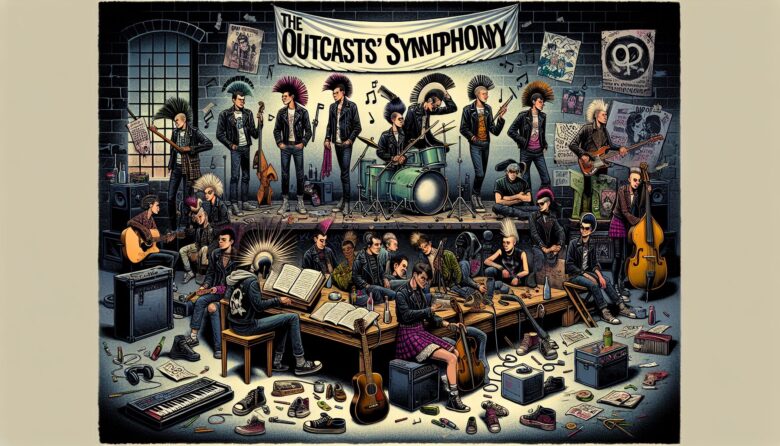
When you think of punk culture, you often think of mohawk hairstyles, ripped clothes, tattoos, and loud, fast-paced music. This creative subculture, born in revolt, has become synonymous with the unconventional, the radical, and the defiant. It has not only been a musical and fashion revolution but also a socio-political one, from its inception until its most recent incarnations.
Origins
The origins of punk culture trace back to the mid-1970s, coming to life amidst a volatile global atmosphere marked by civil unrest, war, economic turmoil, and rising unemployment. Punk was the ultimate form of creative resistance, a way for marginalized and disenchanted youths to scream out their frustrations against the system that failed them.
In a world that felt oppressive and monotonous, punk rock offered an outlet and gave voice to those who felt alienated and disenfranchised by society. Its roots firmly planted in dissent, it was an attempt to repel the status quo and create space for authentic expression. Vibrant, angry, and insurgent, punk united a badge of disobedience with an aesthetic grounded in the raw and uncompromising.
The Rise of Punk Culture
In the 1970s, the punk scene was predominantly concentrated in urban centers such as London and New York, where bands like The Sex Pistols, The Ramones, and The Clash were grabbing headlines. Revolution was the music’s essence, and soon enough, these artists’ rebellious spirit infiltrated everyday life—reshaping fashion, visual arts, dance, and literature.
Punk fashion was a tangible expression of the punk ethos— a clear revolt against the conservative, the mainstream, and the ‘norm’. This rebel style was characterized by its do-it-yourself (DIY) approach and intended to shock, to agitate, and to startle the conventional society.
Even literature was not immune, as the punk ethos invaded it, giving birth to a new genre: punk literature, which offered a raw, confrontational, and controversial take on society’s underbelly. Meanwhile, punk dance, in its thrashing, free-form style, refused the gentle sway of traditional forms, favoring instead violent, vigorous, visceral moves.
The Evolution of Punk
From the 1980s onwards, punk began to evolve, spawning an array of sub-groups like hardcore punk, pop punk, and ska punk, each borrowing from the original punk ethos while adding their defining characteristics. Rebel attitudes extended beyond music and aesthetics, making punk not just a media term but a complex platform for personal and collective expression.
Concurrently, punk culture intersected with political activism, from anti-establishment protests to support for social justice causes. Punk’s mission to challenge oppression and conformity led it to weave a tight bond with anarchy, creating a rebellious counter-culture in which art, music, and ideology were irrevocably intertwined.
The Impacts of Punk
The unadulterated energy of punk did more than just create an outlet for the frustrated. It had a lasting impact on our society and culture. Advocating for individual freedom, authenticity, and radical self-expression, punk facilitated the rise of counter-culture movements, pushing boundaries in music, fashion, and the fine arts.
The DIY ethos of punk played a crucial role in democratizing culture and creative outlets. It empowered individuals to become creators and not just consumers. This principle alone has been monumental in shaping activities and industries like independent music, indie publishing, and even the craft industry.
In conclusion, the punk culture, which began as a counterculture revolution for outcasts and the disillusioned, has made lasting waves in almost every aspect of our society. The impact of punk’s rebellious spirit, visceral aesthetics, and the refusal to conform can still be seen and felt today in fashion, music, art, politics, and even our attitudes. Ultimately, punk taught us that rebellion is not just about breaking rules for the sake of it. It’s about challenging norms, questioning authority, and most importantly, it’s about staying true to oneself in a world that often prefers conformity over authenticity.