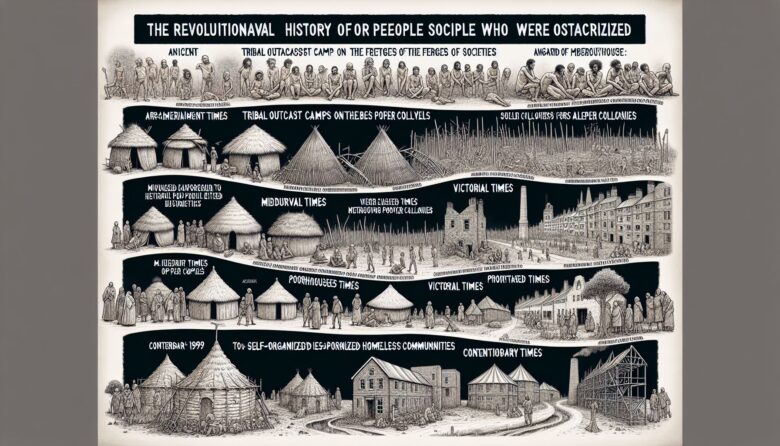
For centuries, society has imposed its rigorous definition of normalcy and conformity on individuals. This demand for uniformity has often led to the marginalization of people who dared to defy these unacceptable norms or were unable to fit into them. However, these societal rejects, or outcasts, found an alternative refuge – they organized themselves into distinct communities, establishing a counter-narrative to the existing social model. The history and development of this revolution offers a fascinating insight into societal transformations and human adaptability.
First Wave – Ancient Civilizations
The idea of an alternative society for outcasts is by no means a modern phenomenon. This concept can be traced back to ancient civilizations. Greece, renowned for its philosophical perceptions, had a section of society dedicated to “Metics” – foreign residents who were barred from the mainstream society due to their non-Greek lineage. Despite being ostracized, the Metics turned this repudiation into a creative revolution by establishing thriving societies that were often reservoirs of highly skilled professionals, contributing significantly to the cultural and economic fabric of ancient Greece.
Similarly, the Roman society had its divergent group labeled the “Infamis”, who were outcasts due to immoral behavior or occupation. Infamis were usually entertainers, gladiators, or sex workers who, despite being disregarded and reviled, built their social networks and communities. These societies served as a support system, nurturing a sense of shared identity and kinship among the outcasts.
The Middle Ages – Outcasts from Religious Conformity
Moving away from ancient cultures, the Middle Ages saw an escalation in religious convictions. Individuals who denied obeying the Church’s diktats found themselves being repelled from mainstream society. This era marked the formation of alternative religious societies, such as the Cathars and the Waldensians, who stood staunch against the authoritarian religious structure. They established their spiritual communities, fostering a revolutionary perspective on Christian scripture and faith.
During these times, the outcasts – the lepers – were instilled into a separate society due to the fear of contagion. Often confined to leper colonies, they developed a unique societal structure that catered to their routines and survival.
Modern Eras – Formation of Hippie and Nomadic Communities
The 20th century brought forward movements that were strong cultural and social backlashes against the prevalent societal norms. The Hippie movement of the 1960s-70s was a revolutionary shift in America. The counter-cultural phenomenon thrived on ideals of peace, communal living, and free love – a sharp contrast to the conservative, war-mired mainstream society.
The Travelers, a nomadic community established in Ireland, is another example. Often denigrated and ostracized for their unconventional and transient lifestyle, the Travelers formed their cohesive society, safeguarding their culture, traditions and language.
Conclusion – The Unrelenting Spirit of Alternative Societies
The journey of these alternative societies for outcasts is a compelling narrative of resistance, survival, and revolution. Despite being vengefully repelled, these societies thrived, underlining the unyielding spirit of humanity. They stamped their indelible mark in the annals of history, not as passive recipients of societal marginalization, but as revolutionary forces challenging societal parameters and rigid norms of conformity.
While alternative societies continue to evolve and be formed in response to the ever-changing societal norms and expectations, their contribution towards driving societal change and broadening the understanding of human existence remains a substantial component of societal evolution.