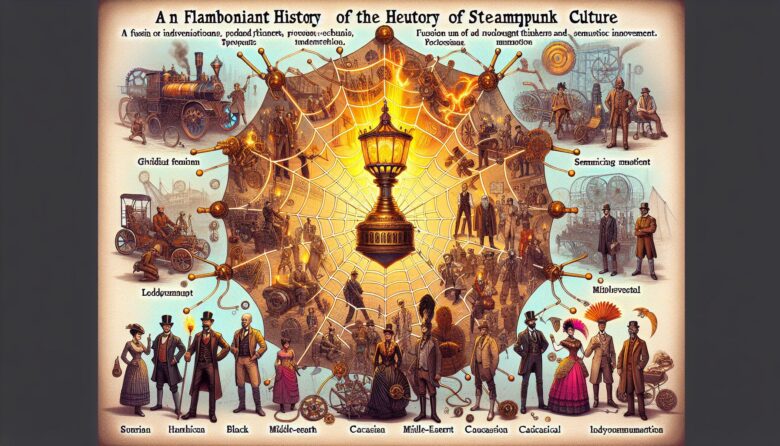
At the dawn of the 1980s, a cutting-edge subculture slithered from the shadows. This was the revolutionary world of steampunk culture; a distinctive, audacious blend of past and future; a fierce rebellion against the monotony of mainstream pop culture.
Wigged tightly in Victorian aesthetics with a spritz of futuristic fantasy, the world of steampunk encourages us to cast aside our conventional lenses and delve into a visually intoxicating universe teeming with copper, cogs, and corsets. Ready to be led on this transformational journey through time and aesthetics? Brace yourself.
The Birth of an Unconventional Utopia
Steampunk is neither only story nor only genre. It’s an aesthetic. It’s a worldview. It’s a culture. Exploding onto the scene during the early 80s, steampunk drew inspirations from creators such as Jules Verne and H.G Wells, painting vivid pictures of a world powered by the steam of the 19th-century industrial revolution.
Long before the birth of steampunk, however, science fiction was already busy cementing its roots – serving up narratives steeped in overtones of potential mechanized futures, laced with elements of rebellion. Yet, the arrival of steampunk offered science fiction a refreshing spin – as it introduced an aggressive yet eloquent tone of voice to speculative fiction.
Steam-Infused Literature: The Power Behind the Punk
Steampunk surfaced largely through literature before becoming a well-established subculture influencing fashion, music, art, and film. The term was coined by science fiction author K.W. Jeter in 1987 in a letter to “Loccus Magazine,” describing a genre of neo-Victorian 80s and 90s writeups. Early works such as “Morlock night” by Jeter himself and “The Difference Engine” by William Gibson and Bruce Sterling opened the gates for budding authors and illustrators to explore this rebellious world, neatly mashing sci-fi, fantasy, and alternative history.
Nonetheless, it wasn’t until the 21st century that steampunk began to gain global recognition, as followers eagerly adopted the aesthetics, embedding it into their lifestyle. Movies such as “Sherlock Holmes” and “Stardust” popularised steampunk elements to a broader audience, metal-enhanced couture started splashing down catwalks, while bands like Abney Park incorporated Victorian visuals into their alternative musical vibes.
The Rise of the Underdog
Steampunk’s uniqueness lies in its unconventional utopian vision of the world. In a society dominated by cutting-edge technology and a tendency towards dystopian visions of the future, steampunk offered an alternative. It dared to advocate hope, celebrating the individual, promoting a DIY ethos and courageously challenging societal norms. Central to this is a touch of anarchy and revolt, questioning established structures, and advocating for liberal humanist ideals.
Yet, it’s not all rosy in the land of corsets and cogs. Despite its growing popularity, steampunk culture has had its fair share of controversy and debate. Critics have raised eyebrows at the romanticisation of the Victorian era, an era known for its colonialist exploits and gross social injustice. They argue that the neo-Victorian aesthetics often hide the murky realities of the time, creating an unnecessarily idealistic and hence misleading illusion.
Roaring Flames of the Future
Despite its stumbling blocks, steampunk culture continues to chart a revolutionary course. A brave subculture that has come a long way from just sci-fi literature to inspiring various forms of art, music, and fashion. It has grown into a movement of people who are not afraid to reject the norms, people who celebrate uniqueness and individualism, navigating their own narrative.
Steampunk’s core tenets of creativity, exploration and rebellion make it an enduring subculture. We live in a world that increasingly values individual expression and understands the power of imagination. Steampunk, in its audacious fusion of past, present, and future, is a trailblazer in this milieu – a daring beacon for revolutionaries.
In the grand scheme of popular culture, steampunk may appear as just another quirky niche. Some might even outright dismiss it as eccentric rubbish. But hold on to your gears, for this punk is here to stay. It is a constantly evolving, bold rebellion that entices us to rethink our society, to question our norms, to dare to dream of a steam-infused world teeming with gorgeously rusted cogs and free-minded souls. Consider this a call to arms, a signal to all who dare to think differently: rise up, wrap yourself in those corsets and top hats, forge your brass goggles and welcome to the revolution!